Skip to main content \(
\newcommand{\lt}{<}
\newcommand{\gt}{>}
\newcommand{\amp}{&}
\definecolor{fillinmathshade}{gray}{0.9}
\newcommand{\fillinmath}[1]{\mathchoice{\colorbox{fillinmathshade}{$\displaystyle \phantom{\,#1\,}$}}{\colorbox{fillinmathshade}{$\textstyle \phantom{\,#1\,}$}}{\colorbox{fillinmathshade}{$\scriptstyle \phantom{\,#1\,}$}}{\colorbox{fillinmathshade}{$\scriptscriptstyle\phantom{\,#1\,}$}}}
\)
Exercises 23.4 Practice Exercises
Exercise Group.
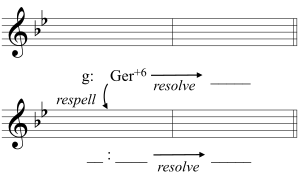
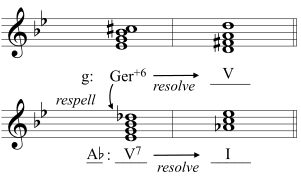
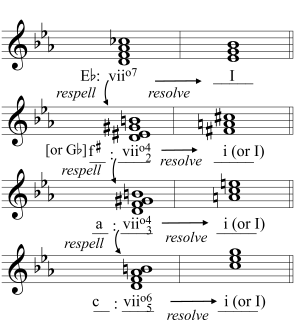
1. Notate the specified chord, resolve it, then notate and resolve the enharmonic respelling(s).
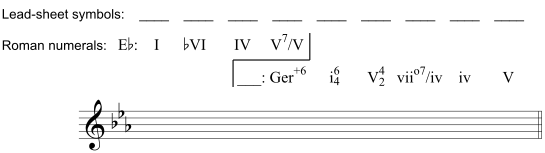
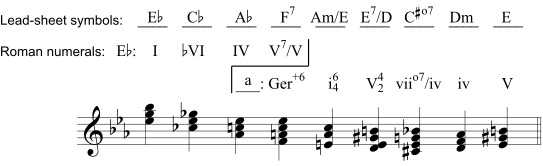
2. For the following Roman numeral progressions, label the chords with lead-sheet symbols, specify the new key, and notate all of the chords in the appropriate inversion on the staff below. The enharmonic pivot chord can be spelled correctly in only one of the two keys.
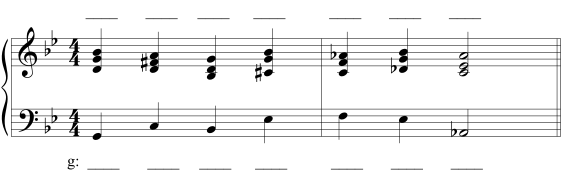
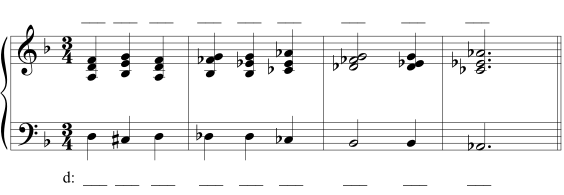
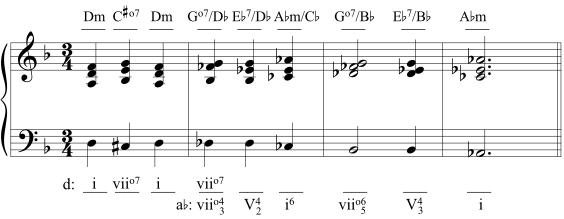
3. Analyze with lead-sheet symbols and Roman numerals and label the enharmonic pivot chords in the examples below.
Figure 23.4.1.
Exercise Group.
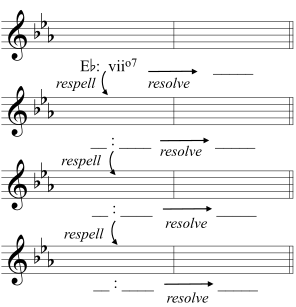
4. Notate the specified chord, resolve it, then notate and resolve the enharmonic respelling(s).
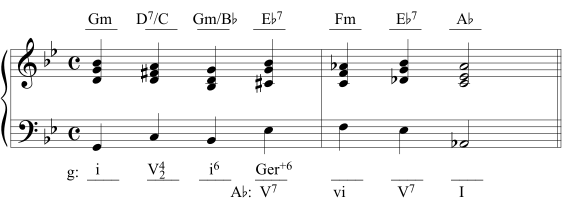
5. Analyze with lead-sheet symbols and Roman numerals and label the enharmonic pivot chords in the examples below.
Figure 23.4.2.