Skip to main content \(
\newcommand{\lt}{<}
\newcommand{\gt}{>}
\newcommand{\amp}{&}
\definecolor{fillinmathshade}{gray}{0.9}
\newcommand{\fillinmath}[1]{\mathchoice{\colorbox{fillinmathshade}{$\displaystyle \phantom{\,#1\,}$}}{\colorbox{fillinmathshade}{$\textstyle \phantom{\,#1\,}$}}{\colorbox{fillinmathshade}{$\scriptstyle \phantom{\,#1\,}$}}{\colorbox{fillinmathshade}{$\scriptscriptstyle\phantom{\,#1\,}$}}}
\)
Section 10.5 Escape Tone
An
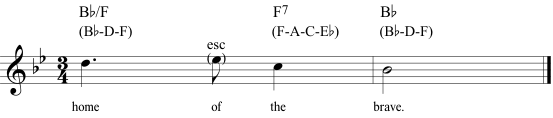
escape tone is approached by step and left by leap in the opposite direction. An easy example to remember is the end of the “Star-Spangled Banner.” The word “of” in “home
of the brave” is an escape tone.
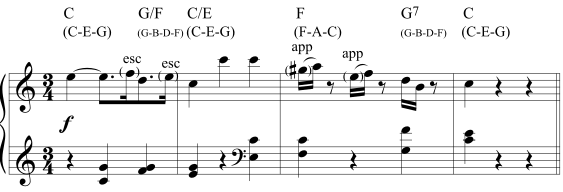
Figure 10.5.1. Francis Scott Key and John Smith, “Star-Spangled Banner” (1814) Here is another example, with escape tones used in a melodic sequence.
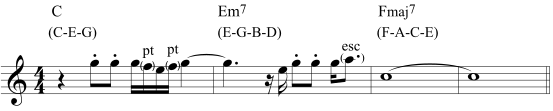
Figure 10.5.2. Joseph Haydn, Piano Sonata in C Major, Hob. XVI:35, III (1780) Here is an example of an escape tone in popular music.
Figure 10.5.3. Paul McCartney and Linda McCartney, “Silly Love Songs” (1976)