Skip to main content \(
\newcommand{\lt}{<}
\newcommand{\gt}{>}
\newcommand{\amp}{&}
\definecolor{fillinmathshade}{gray}{0.9}
\newcommand{\fillinmath}[1]{\mathchoice{\colorbox{fillinmathshade}{$\displaystyle \phantom{\,#1\,}$}}{\colorbox{fillinmathshade}{$\textstyle \phantom{\,#1\,}$}}{\colorbox{fillinmathshade}{$\scriptstyle \phantom{\,#1\,}$}}{\colorbox{fillinmathshade}{$\scriptscriptstyle\phantom{\,#1\,}$}}}
\)
Section 10.10 Retardation
A
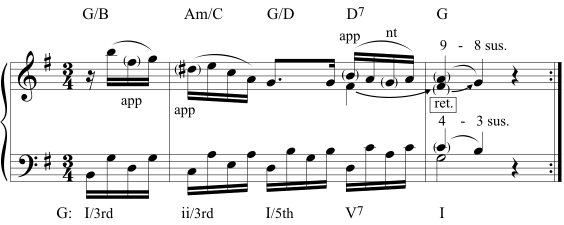
retardation is usually an accented non-chord tone, meaning it occurs on a downbeat. A retardation is approached by the same note and resolves up by step.
Figure 10.10.1. W.A. Mozart, Piano Sonata in C major, K. 545, II (1788) Classical composers like Mozart often used retardations and suspensions at cadences in slow movements.